Thứ Hai, 11 tháng 1, 2016

Download Clash of Clans v8.67.8 [Mod Money] Apk Free Download

clash of clans apk download


From rage-­filled Barbarians with glorious mustaches to pyromaniac wizards, raise your own army and lead your clan to victory! Build your village to fend off raiders, battle against millions of players worldwide, and forge a powerful clan with others to destroy enemy clans.

PLEASE NOTE! Clash of Clans is free to download and play, however some game items can also be purchased for real money. If you do not want to use this feature, please set up password protection for purchases in the settings of your Google Play Store app. Also, under our Terms of Service and Privacy Policy, you must be at least 13 years of age to play or download Clash of Clans.

ALSO SEE :- Download 8 Ball Pool v3.4.0 Apk [Mod Money] Free For Android 

A network connection is also required.

FEATURES


  • Build your village into an unbeatable fortress 
  • Raise your own army of Barbarians, Archers, Hog Riders, Wizards, Dragons and other mighty 


Fighters


  • Battle with players worldwide and take their Trophies
  • Join together with other players to form the ultimate Clan
  • Fight against rival Clans in epic Clan Wars 
  • Build 18 unique units with multiple levels of upgrades
  • Discover your favorite attacking army from countless combinations of troops, spells, Heroes and Clan reinforcements 
  • Defend your village with a multitude of Cannons, Towers, Mortars, Bombs, Traps and Walls
  • Fight against the Goblin King in a campaign through the realm

WHAT'S NEW


  •  New Winter theme!
  •  Bug-fixes for the new Shield system and game crashes
  •  New info screen when tapping the Shield icon shows exact Personal Break timer status
  •  Fixed and cleaned up various UI issues
  • 8.67


DOWNLOAD CLASH OF CLANS MOD APK


  • One of the Biggest Clash Updates - Ever!
  •  Town Hall 11, new Hero Grand Warden & new defense Eagle Artillery!
  •  New troop levels, defense levels, and Clan Spell donation
  •  Revamped Shield system that lets you attack whenever you want
  •  Bigger League Bonuses, Trophy offers, and so much more

Thứ Năm, 7 tháng 1, 2016

A Quick Idea for a Dice Placement Euro Game

Dice

Last year a lot of publishers said they liked my games, but wanted to see what I'd do next. Specifically, what games I could design beyond the realm of pure card games. Something like a medium weight euro.  So as I do my morning game design doodles, I'm dipping a toe into classic euro mechanisms like worker placement or dice placement. Here's one idea, loosely inspired by Greg Stolze's One-Roll Engine.


Assume there is a pool of eight six-sided dice and a board with six numbered spaces. Also assume that this board represents six different actions you may take, in the spirit of other dice-placement games like Alien Frontiers, Kingsburg, or Euphoria.


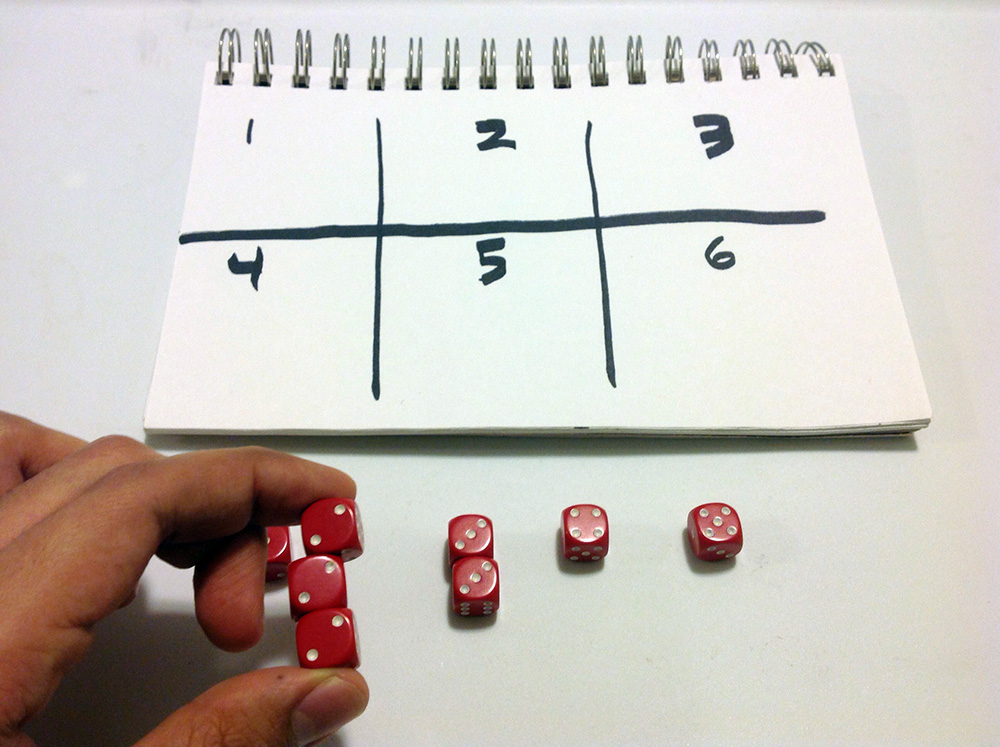
On your turn, you roll the dice pool and sort the results into groups according to their face value. Here we have 1x1, 2x3, 3x2, 4x1, and 5x1.


As the active player, you get first choice from this pool to place one of these groups onto the board. You may place a group onto a space that matches the face value or the size of the group.


So this group of 2x3 could be placed on the "2" space...


...or on the "3" space.


The next player to your left gets to choose another group from the pool to place on the board, following the same rules.


So this 1x5 could be placed on the "1" space...


...or on the "5" space.


Each subsequent player takes one group from the pool and places it on the board until all the dice have been placed. Note that it is possible for players to place more than once on a single turn if there are enough groups to go around the table multiple times, depending on the number of players. For example, if there are six groups and four players, the active player and the player to their left will place twice.

Once all the dice have been placed, that ends your turn as active player.


Thereafter, the player to your left becomes the new active player and begins their turn. They clear the board and reroll the entire pool of dice. They take their first pick of the available groups, followed by the player to their left, and so on, until no dice remain.


But what if there were a map instead of the board?


What if the face value of the set represented the type of dude you could put on the map and the size of the set represented how many you could put on the map? Or vice versa, since large sets are statistically rarer?


Maybe a larger set, like a set of three, allows you to build more substantial structures on the map?

There are a lot of open questions here, but I'm curious to see how it all turns out. What if the game had a map and a board? Assume the theme is dudes exploring this new continent. The board had actions like Settle Dudes, Migrate Dudes, Build Structures, Grow Resources, Harvest Resources Resources, Sell Resources. All of which pertained to various types of bits that are on the board itself? That opens up even more questions! Like, what if the power of these actions varies on a number of different factors? For example:

--~--

Settle Dudes
Place dudes on a space of the map matching the size of the group or the face value.

Face = Number of Dudes

Size : Type of Dudes
1-2: All Farmers
3-4: One (Explorer or Scribe) and all Farmers
5+: Two (Explorer or Scribe) and all Farmers

--~--

Migrate Dudes
Move dudes from one space on the map to an adjacent space of the map.

Face = Number of Dudes

Size : How Many Dudes Perish Along the Way
1-2: Two Dudes
3-4: One Dude
5+: No Dudes

Migrating Explorers raises the set value by one increment. So if you migrate four Farmers, one of them would perish along the way. However, if you replace one of those Farmers with an Explorer instead, that boosts your Size by 1, so it's effectively 5. That means all four of those migrating Dudes would survive the migration.

--~--

Build Structures
Put a structure on a space of the map where you have at least one scribe.

Face = How Much Gold You Earn

Size : How Many Structures You Can Buy
1-2: One Structure
3-4: Two Structures
5+: Three Structures

You may keep as much leftover gold as you have scribes in your chosen space of the map. Actually building anything is optional, so you could just take this action to get some gold.

--~--

Grow Resources
Put resource tiles on a space of the map where you have at least one farmer.

Face = Number of Resources

Size: How Much Control You Have
1-2: All resources randomly drawn from the bag.
3-4: Choose two of the resources.
5+: Choose four of the resources.

Each Farmer you have on a space raises the Size by one increment. So if you used three dice and chose a space where you have two farmers, that effectively raises the Size to 5, allowing you to choose four of the resources.

--~--

Harvest Resources
Take resource tiles from a space of the map where you have at least one farmer. (Note that these don't need to be resources that you grew.)

Face = Number of Resources

Size: How Many Crops are Lost in the Process
1: Three Tiles
2-3: Two Tiles
4-5: One Tile
6+: No Tiles

Each structure on a space will raise the Size by one increment so you lose fewer crops when harvesting.

--~--

Sell Resources
Exchange matched sets of resource tiles for coins or points.

Face = Number of Sets You Can Sell

Size: What You Earn
1: 1 Point and (1 Coins per Set)
2: 3 Points and (4 Coins per Set)
3: 6 Points and (9 Coins per Set)
4: 10 Points and (16 Coins per Set)
5+: 15 Points and (25 Coins per Set)

Sacrificing two Explorers from the same space on the map will boost your Size by one increment.
--~--
So that's just a quick idea from this morning. I must admit I'm a bit overwhelmed at the big open design space available in a 90-minute euro game compared to a 20-minute card game. Hopefully this little dice placement mechanism offers a sensible core loop around which I can build that bigger experience.

Thứ Tư, 6 tháng 1, 2016

Tile-Laying: the Tile-Laying Game


Drew Hicks and I have been working on an isometric tile-laying game for the past couple of months in anticipation of the Greater Than Games metagame contest. The contest calls for games where the core mechanism is also the theme, for example Deck Building: the Deck Building Game, where you're actually building a deck for a house. That sort of thing.

We're happy to announce that Tile-Laying: the Tile-Laying Game is now ready for public testing!

Welcome to the brutal, high-stakes, life-and-death world of archeological restoration internship. Here, rival interns burn their brains reconstructing a tiled Ancient Greek plaza. Place tiles on the two walls and the floor in order to earn the most renown. Whoever earns the most renown wins!

It's a two-player game played on a 4x4x3 isometric space with a floor and two walls. Players take turns placing their tile or a blank tile onto the plaza. When a line of eight tiles is complete, whoever has the most tiles on that line scores their tiles. The symbols on each tile shows different ways to score points.


Eight random gold tiles form a baseboard along the bottom of the two walls. Whoever completes a line that intersects with the baseboard gets to resolve the baseboard tile, even if their opponent actually scored it. Baseboard tiles score points or allow special actions. We've got ten baseboard tiles developed and tested so far, but we're eager to add to that lineup. It's a nice bit of variability for each game.

Hope you dig it! Check it out here.

Thứ Ba, 5 tháng 1, 2016

Testing 2- and 3-player Trickster


As a part of general development for Trickster, I'm taking a hard look at the 3-player and 2-player modes. The basic game has a nice sweet spot with 4-6 players, but to make the game viable at retail, we need to legitimately have a "2" on the box. So here's what I've got in the lab right now. For those of you who have at least two Trickster sets, here's what you need to do.

--~--

Set Up Changes
Your deck will need one more hero than normal. So, eight heroes in seven different colors, for a deck of 56 cards. (For my home tests, I liked adding the Miner from Symbiosis to the Fantasy set. She's a nice complement to the Rogue and keeps the overall effects pretty easy to remember.)

Deal eleven cards to each player’s hand.

For Three Players: Clear an additional section of the play area called the Timeline. Set it to the opposite side of the Trash from the Deck. Deal a row of twelve cards to the Timeline face-down.  Turn the card at the front of the line face-up.

Play Changes
For Two Players: Each player will take at most two turns per trick instead of just one. In essence, you're playing a four-player Pot with just two players. So, the maximum size of the Pot is four cards. (Example: A is the leader and plays a card. B is the Trickster and plays the second card, thereby establishing the pattern. A plays the third card. B plays the fourth and final card.)

The oldest player takes the first turn as Leader in the first trick. The second player is the Trickster.  Thereafter, each player alternates Leader and Trickster roles regardless of who busted the prior Pot.  

For Three Players: No player takes on the role of the Leader. Instead, at the start of each Trick, the card at the front of the Timeline is added to the Pot as the first card. Immediately reveal the next card in the line.

The oldest player takes the first turn as Trickster. Each player takes turns being Trickster clockwise around the table, regardless of who busted the prior Pot.

Endgame Changes

For Three Players: In addition to the normal endgame trigger, the game ends if there are no more cards remaining in the Timeline to add to the pot.

--~--

I'm trying to avoid a "phantom player" mechanism, but so far the Timeline mechanic in the three-player mode has proven to be a nice compromise. It doesn't force anyone to play a dummy player, but still allows a new type of strategy as you plan ahead for what you'll play on your upcoming turn as trickster.

If you get a chance to test these rules, please leave a comment! Thanks very much!

Thứ Hai, 4 tháng 1, 2016

The Daily Huddle for Work-From-Home Freelancers

Seemingly Surreal Swallows in a Spring Snowstorm
It's a new year and a fresh chance to get started on some new habits. One habit I've kept up since becoming a freelancer is the Daily Huddle. A bunch of work-from-home freelancers and I meet every weekday at 10am EST for about 20 minutes to share three things:

- #1 Priority for the Day
- A question or bit of help for the group
- One bit of news, which is ostensibly supposed to be a professional update but has lately digressed into Star Wars. A lot.

I picked up this habit when I was working in an office, but it's an easy and convenient way to keep up human contact with fellow professionals. We have artists, writers, and game designers on a regular basis. Join us at this URL!

Thứ Sáu, 1 tháng 1, 2016

Smart Play Games Report for 2015


Happy new year, everyone! It's been a long time since I've done a proper sales report, which probably foreshadows the transitions from 2015. I kicked off the year knowing that I couldn't repeat the same pace I held in 2014, releasing one new game or product each month via DriveThruCards' POD service. That wasn't sustainable for the long-term, but it really yielded great rewards and I'm glad I did it. Without further ado, let's look at the numbers and break down some context.

The Numbers


Here are the sales numbers for each product in 2015 (in red) compared to 2014 (in blue). The good news is that every product that existed in 2014 sold more units than it did in 2015! Across the board growth is very positive.


These are the gross sales numbers for each product in 2015 compared to 2014. As you can see with some small low-priced products like the Koi Pond promo cards, the sales numbers far exceed their actual dollar gross. These numbers fluctuate month by month based on whatever promotional discounts I've got in place at that time.


And here are the actual earnings from each product in 2015 compared to 2014. This is what's left over after DriveThruCards takes its cut.

Funny how on all of these charts, the big 800-pound gorilla is Kigi. Koi Pond used to be my flagship product and the high bar for anything else in my catalog, but holy cow Kigi earned double Koi Pond's 2015 earnings and tripled Koi Pond's 2014 earnings! Wow, what a year.

Okay, let's break down the year by subject.

Heir to Europa
2015 was a very experimental year. Early on, I wanted to pick up licenses for other designers' games, hoping to offer others the same success I'd had with my POD model. Nick Ferris agreed to let me publish Heir to Europa, a lovely trick-taking card game. Unfortunately, I hadn't anticipated how much other business would distract me from properly promoting and supporting Heir to Europa in the latter half of 2015. I really want to release more standalone suits for the game, but a proper rules tutorial should be produced first. That has unfortunately been delayed by my own freelance work ramping up into December. I still feel bad about how slowly that's been developing. I hope 2016 will be a year for Europa.

POD Imports
As a part of 2015's experiments, I pursued some licenses for foreign games that I thought would be easy to release via POD. Most of these games have extremely short local print runs and never reach US shores, so I thought POD is a great way to "import" the games in an affordable and efficient form. I still think POD has the strong potential to take on that role, but perhaps I'm not the best salesman for that proposition. For now, traditional import and licensing retail seems to be the more attractive channel at the moment. The BGG Marketplace is doing some interesting things with this area of business.

A La Kart
I began the year deciding I'd focus on one game instead of my manic pace from 2014. That game would be A La Kart, which I brought to UnPub and got a LOT of really good feedback on. However, it became clear that the theme and the mechanics, while both very fun and interesting, didn't match each other well. So around BGGcon, I decoupled the theme and mechanics from each other and designed a better fitting game for the wacky racing theme. So far, tester response has been very good and it's currently being evaluated by a major publisher!

Becoming More "Legit" at BGGcon
The impostor syndrome bit me hard at weird moments this year, most notably in still thinking of myself as a novice game designer. At BGGcon, some really veteran designers whose opinions I respect suggested that I actually shouldn't attend the speed dating event as it's really meant for rookies. I had counted myself as a rookie as well, but these vets said, no, I'm actually somewhere in the middle. I've got a few games under my belt now and I should be pursuing more formal meetings at conventions. Fortunately there was time to reorient my strategy and get more of these face-to-face meetings scheduled. Hope something good comes from them!

Princess Bride: As You Wish
Princess Bride: As You Wish also released this year, which was an important reminder of the long production cycle required for major retail releases. I originally signed that license back in 2013, then after some development it got kickstarted in late 2014, finally releasing to the retail channels just a few months ago. I have to keep these long lead times in mind as I pursue new licenses.

POD business and Retail Business
One thing I found out at BGGcon was the awkward position my POD successes had put me in. Am I an indie designer? Am I a publisher? Am I a beginner? Certainly the POD games were getting attention and buzz, but that didn't necessarily translate into products which would have strong retail or kickstarter potential. I referred to this as the Chrome Ceiling. POD got me to a certain point in my career, but proper retail with bigger games was the obvious next step. As I learned from Princess Bride, it could be up to two years before a game hits retail and bills are coming in the meantime. So while I develop and pitch bigger games, I have to find other ways to supplement my income month-to-month.

Patreon and Etsy

That's where my updated Patreon came in very handy in the latter part of 2015. By changing to a monthly schedule and releasing more videos more regularly, Patreon offset some very slow sales months from my POD store. Selling some of my complimentary Japanese and Chinese editions of Koi Pond and Kigi also helped fill in the gaps. That's not a long-term solution, but it helped during a few leaner weeks.

Kigi and Kodama
Kigi and Kodama are the standout milestones from this year. It's hard to believe how eventful a year it's been for these games. Kigi got picked up by Japanese publisher Gamefield and sold out at Tokyo Game Market in May. Then a few months later, Action Phase were such big fans that they wanted to develop the core mechanisms into a whole new game. Kodama: the Tree Spirits went on to raise almost $100,000 on Kickstarter and become their highest funded, most backed project to date. Kodama is going to be in the Mensa Mind Games competition this year as well, which will be very  exciting to watch.

Trickster
Trickster has had an even faster lifecycle than Kigi. I released my first Trickster sets in the middle of 2015. Now I'm happy to announce Action Phase Games is also picking up Trickster for retail publication! They really liked the gameplay and we're currently developing it into a bigger game in a bigger box. Something about the scale of Smash Up or even Dominion. We have big plans ahead. More details to come!


Thanks very much for your support in the past year!