Hiển thị các bài đăng có nhãn lab. Hiển thị tất cả bài đăng

Thứ Tư, 7 tháng 9, 2016

Chess Terrain Cards?


This was a silly little product I was mulling a while back. It's too goofy for abstract players and too abstract for goofy players. So, probably just right for my sensibilities. :)

It's deck of cards with 2x3 grid of spaces. Eight cards arranged as shown above would make the middle six rows of a chess board. Each player's home row is implied by the dotted lines. You'd set up a standard chess game and play on this modular board, using the special effects on the spaces shown above.

This is obviously designed for chess, but could easily combo with the transparent card abstract game I posted as well. It's one of those little ideas that's not really marketable at anything but a niche scale, but I probably great for a POD product. It's been a long time since I've released any new product and the longer the hiatus, the more pressure I feel to make the next one really special. Perhaps instead I should just focus on these sorts of silly ideas.

What do you think?

Thứ Hai, 5 tháng 9, 2016

Poker Auction Alpha Prototype


Lately I've been thinking about designing card decks that act as supplements for a standard deck of playing cards you already have at home. The idea is that with one of these supplements and a deck of playing cards, you'd have a deep and extremely portable strategy game in your favorite genre. Auction games, area control games, etc.

First up, a poker auction game. The idea here is that you could play out an auction using poker hands instead of money. I liked the idea that instead of a 1:1 ratio of dollars to bidding power, a poker hand could have an unpredictable bidding power.

To get the alpha on the table as soon as possible, I just cannibalized a first edition of Sushi Go as a placeholder set of set collection cards. I also grabbed a Hocus deck since it had a convenient summary of poker hands. With the Game Designers of North Carolina, we play stormed the following game:

SET UP
Remove the chopsticks from the Sushi Go deck. Shuffle it together and deal out five lots of three random Sushi Go cards each, lined up in a row. Shuffle the poker deck. Each player begins with a random hand of five poker cards.

PLAY
One lot goes up for auction at a time, starting from the front of the line. Each player takes turns bidding or passing on it.

Bid: Lay a valid poker set as a bid in front of you. (The lowest bid is "High Card," a single card.) You may instead add a card or cards to your existing bid. These new cards may raise the bid to a better poker set or be a "kicker." In either case, your new bid must be the strongest bid on the table. If it is not, then you must pass.

  • A kicker is a card that is not technically part of a poker set, but will break ties between two poker hands of equal strength. For example, of you bid a High Card of 8, then Matt bids an 8, and Ruth also bids an 8, you can then add a 4 to your bid. If no one else can add a higher card to their bid as a kicker, or make their card a stronger poker set, then you would win the auction.

Pass: Draw a card from the deck. You're now out of the round.

Once all but one player has passed, the player who has the strongest poker set wins the lot. If two or more players have equally strong bids, they cancel each other out and the next strongest bid wins the lot.

When you win a lot, its cards go into your tableau. The winner discards their bid cards. Anyone else returns their bid to their hands.

The hand limit is nine cards total, so at this point you must discard down to nine if necessary.

Then the next lot in line goes up for auction, following the procedures described above. This continues for each of the five lots. After the fifth lot is won, that round is over.

All sets but the Puddings score at the end of the round, if able. If any of your cards score, they must be discarded. If any of your cards do not score, you can keep those cards in your tableau going into the next round.

To begin a new round, deal five new lots for the next round. Players keep all of their poker cards in their hand going into the next round. Play one round per player.

The game ends after one round for each player. The player with the most points wins.

CHANGES
GDofNC recommended that instead of a poker deck the game could use a Pairs deck.

If a Pairs deck, then the auction winner would be whoever plays the largest set of matching cards. If tied, whoever played the lower ranked set wins. That seemed easier than figuring out poker hands. It also makes a nice balance in a Pairs deck as more common cards are powerful as a group, but less powerful individually.

While certainly more accessible, I'm still not sure if a Pairs deck has the versatility of a poker deck though. It also means departing from this little conceit that started this whole idea in the first place. Perhaps that's one darling I should drop right away, but I'd like to give it a shot one more time.

Thứ Tư, 17 tháng 8, 2016

Translating Sports to Tabletop Mechanics [Design]

Men's Pole Vault

It's Olympics season and I've been particularly fascinated with the game design behind the rules and formats for each sport. Here are some quick notes about how they might translate if they were rules for a tabletop game.

Modern Pentathlon has a fencing round where the lowest ranked fencer duels the second-lowest. Whoever wins moves on to duel the next lowest. This continues with the winner of each duel climbing the ranks and the loser being removed from that round and earning points accordingly. I could see a Magic: the Gathering tournament being formatted like this as a casual event.

Miss and Out Cycling has a large group of cyclists on a track doing laps around the course, but the last cyclist to cross the finish line is eliminated from that race. Laps continue in this manner, with more cyclists being eliminated. This is more or less how Get Bit works, replacing individual racers with 5 hit points for each player.

Olympic Diving has 7 scores from judges kept separate from one another, then the highest and lowest two scores are ignored, the remaining scores are multiplied by the difficulty level. It's a bit convoluted, but I could see something like this in an early Euro sort of game.

Volleyball has an interesting combination of racing mechanics and tennis victory. There are some variations, but generally each round of play may only end after a team has X points. Once a team has a point difference of Y points over their opponent, they win the round. This might lead to some extended games at the table, but I'd love to see a 2p abstract formatted like this.

Pole Vault has a classic push-your-luck mechanism. The difficulty is raised (literally) throughout the game, then players must decide to pass or attempt the vault. Three missed attempts eliminates the player. This reminds me a lot of Welcome to the Dungeon, but it might work with any push-your-luck tabletop game.

Cool stuff! Any other Olympics games you think might translate to tabletop mechanisms?

Thứ Sáu, 17 tháng 6, 2016

Transparent Card 2-Player Abstract


2-player abstracts are really hard to make commercially viable, but that's never kept me from noodling them a bit. This is one idea that I've had on the back burner for a long time while I was focused on card games, but I'm pushing it forward a bit now that Onitama and the Duke are more prominent.

The basic idea is using transparent cards like Gloom or Mystic Vale with an abstract movement UI as seen in Onitama, the Duke, and Tash-Kalar. Each player has identical set of unique pieces. Call them A, B, C, D, and E.

To set up the game, each player draws five cards from the deck. Each player simultaneously secretly picks then reveals a card to assign to each type of piece. In the above example, player 1 picked Elephant and player 2 picked Crab. For this game, A has the traits and powers of Elephant and Crab. Then you do the same for B, C, D, and E.

Then you play the remainder of the game using those movement rules. I'm imagining the game played on a 9x9 board, I can playtest on the lines and vertices of a normal chess board.

The goal of the game is to score three points. If you begin your turn with one of your pieces on your opponent's center space on their home row, you score three points and win the game immediately. Most of the rest of their home row scores 2 points. The corners of the home row scores 1 point. So you could be aggressive and aim for your opponent's heart or do a more controlled overwhelming push.

Thứ Năm, 2 tháng 6, 2016

An Investigative Reporting Push-Your-Luck Game

Reporter

I've been noodling a push-your-luck game themed around investigative journalism for a while now. At first I was exploring a reverse-auction mechanic, but the push-your-luck aspect of Circus Flohcati, Incan Gold, Dead Man's Draw, and Abyss seemed to make more sense. The idea of "digging" into the deck as a mechaphor of investigation sounded really compelling. I also really love games where the only prep you have to do is shuffling one deck of cards.

Here are the basic ideas I have right now, which haven't entirely gelled yet into a real game, but are close enough to get to the table by next week.


Cards have ranks and suits, noted by the number and large symbol along the top corner. Each suit represents different subjects your reporter is following.

Below the suit is a little arrow pointing at another suit. Lower ranks have more arrows than higher ranks. 1s are "?" and have an arrow pointing to "?"


Setup


Shuffle the deck. Deal one card to each player's hand. Discard ten cards to the discard pile face-up.

Each player begins with 0 points, 10 Credibility, and 5 Money.


How to Play

On your turn, you'll dig: Reveal a card from the deck and place it in the center of the play area. Then you must decide whether you'll stop or keep digging.
  • Keep digging: Reveal another card and place it beside the last revealed card. Then decide again whether to keep digging or stop. If you ever reveal two of the same suit, you're caught and must do the penalty action noted by the matched suit.
  • Stop: Take one card from the play area into your hand and do the action noted by that suit. Actions are more powerful the more cards there are in the play area.

At the end of your turn, you may file a report. Lay down a set of cards from your hand in front of you. Reports are either open or closed.
  • Open: Your report connects suits to each other in a linearly. For example, Media connects to Military connects to Government. When you file an open report, score the lowest rank in the report as points.
  • Closed: Your report connects suits in a closed loop. For example, Media connects to Military connects to Governments, which also connects back to Media. When you file a closed report, score the highest rank in the report as points.
When you file, you may discard 1 Money to fill in any missing connections. The next time you do this costs 2 Money. The next time after that costs 3 Money, and so on.

"?" may be used to fill any missing connections for free.

Keep your filed reports separate from one another, face-up so everyone else can see them.

This ends your turn. The next player begins their turn as noted above. Each player must dig at least once on their turn before deciding to stop.


Suits

This is just a quick list of possible suits, their actions, and their penalties. Nothing final, just something to test at the table ASAP. In all cases, the "__" in actions is the number of cards in the play area.

Entertainment: Take __ cards from the top of the discard pile. Penalty: Discard __/2 cards from your hand.

Sci-Tech: Look at __x2 cards from the top of the deck and take __ into your hand. Penalty: Discard __/2 cards from your hand.

War: Swap __/2 cards from any opponent's reports for cards your hand. The swapped cards must be the same suit. Penalty: Discard __/2 cards from any of your filed reports.

Business: Gain __x2 Money. Penalty: Discard __ Money.

Politics: Spend __ Money to gain __/2 Credibility. Penalty: Discard __/2 Credibility.

International: Discard up to __/2 cards from your hand to gain that much Credibility. Penalty: Discard __ Money.

Local: Discard up to __/2 cards from your hand, then take that many cards from the top of the deck into your hand. Penalty: Discard __ Money.

Rumor: Add __ cards from your hand to any of your filed reports. Penalty: Discard __/2 Credibility.

I'm sure there are other subjects that would fit in this list and these subjects could have more thematic effects. That's it for now though.


End of Game

When the deck runs out, the game is over.


At the end of the game, you get bonus points for doggedly reporting on the same subjects over and over again. For each suit appearing on more than one of your reports, score the highest rank in that series. In the example above, you reported on War three times, the highest rank of which is 8, so you score 8 points.

Money doesn't affect final scores.

Whoever has the most Credibility doubles their point total.

The player with the most points at the end of the game is the winner.

I like the idea of two competing strategies being equally valid: File fewer reports while relying on your Credibility to carry you through - OR - Spend a bunch of money filing shoddy reports aiming for an insurmountably high score, regardless of your Credibility.

Thứ Hai, 22 tháng 2, 2016

A Drafting/Turn Order Mechanism

Scottish Championship Car Racing

Back in December 2015, I was noodling a simple turn order drafting mechanism with some random bits I had around the lab. Little did I know that a similar mechanism had been incorporated into Madeira, but I thought it worth posting about for posterity in case I explore it for future designs.

A 5 player game starts here:

From first to last, each player moves their pawn beside any card and takes it, along with any of its chips:


Once the cards and chips are gone, the pawns remain, thus establishing a new turn order for the subsequent draft. I could see this drafting mechanism imposed onto a track, so on any turn you can move up to 5 spaces forward, collecting whatever is available on that spot. There would need to be competing but comparable motives for collecting a card, moving up in turn order, or moving along the track. I'm very curious to see a racing theme for this mechanism. What do you think?

Thứ Hai, 15 tháng 2, 2016

Poker Hands with Numbered Cards without Suits


I love games like No Thanks, Little Devils, For Sale, 6 Nimmt, and The Game, which use a deck of sequentially numbered cards, no suits, and barely any other components. It’s a wonderful design challenge that I return to from time to time. In that exploration, I came up with a list of “poker” hands that you could put together with a deck of 50 numbered cards numbered 01-50. These should work with any size deck, with some slight tweaks. I’m not sure how or when I’ll use this mechanism, but I share it with you here for your own games if you want to use it.

These hands are ordered from best to worst.

Fool’s Hand
01, 23, 45...
At least three cards with an ascending sequence of digits. If tied, the highest rank in either hand wins. (This is a Star Wars joke for the fans out there.)

Straight Flush
Good:   03, 11, 28, 34, 42
Bad:    03, 24, 05, 36, 17
Ugly:   18, 20, 13, 04, 50
Ascending sequence of five cards. If tied, good beats bad, bad beats ugly. If still tied, the highest digit wins.

Four of a Kind
Good:   10, 13, 14, 18
Bad:    09, 29, 39, 49
Ugly:   02, 25, 28, 42
Four cards that share a digit. If tied, good beats bad, bad beats ugly. If still tied, the highest digit wins.

Full House
Good:    10, 13, 14, 35, 38
Bad:     08, 28, 38, 12, 02
Ugly:    12, 23, 28, 48, 24
Three cards that share a digit and two cards that share a digit.  If tied, good beats bad, bad beats ugly. If still tied, the highest digit wins.

Short Straight
Same as a Straight Flush, but fewer cards (two-to-four). If tied, more cards wins. If still tied, highest rank wins.

Three of a Kind
Same as four-of-a-kind, but three cards.

Two Pair*
Good:    10, 13, 45, 48
Bad:     08, 58, 32, 72
Ugly:    08, 28, 64, 43
Two cards that share a digit and two cards that share another digit.  If tied, good beats bad, bad beats ugly. If still tied, the highest digit wins.
*These examples assume a deck larger than 50 cards.

Pair
Same as Two Pair, but only one pair sharing a digit.

High Card
Highest ranking card wins.

I like that using the "tens" and "ones" digit or a mix makes an intuitive sub-hierarchy within a traditional poker hand hierarchy. I'm not 100% sold on calling them Good, Bad, and Ugly, they just seemed to make sense to communicate their relative difficulty.

I also figured out the "rarity" of digits in a 01-50 card deck which makes some interesting game design fodder.
Digit  Frequency
0      14
1-4    15
5      6
6-9    5 
Interesting that the frequency of 0-5 is almost triple that of 5-9. Should that be reflected in the ranking of these poker hands? Almost any five-card hand worth anything will be built out of 0-4 since they're so much more common. I could be wrong about that assessment though. This is all just conjecture. I'm still trying to find the right game or theme where these rankings would make more sense than just using a more traditional card deck and poker rankings. Maybe you can find a home for this thing. :)

Thứ Tư, 27 tháng 1, 2016

"Grid Bidding" Mechanism in the Lab


Here's a grid-bidding mechanism that I've had in the lab for some time and finally set down on paper earlier this week. Assume a two-player game for now: red and blue. Also assume each player has tiles numbered 1-7.

Set Up
To set up, each player takes turns setting one tile face-down along the top or side of the grid shown above.

Play
Each player takes turns placing one of their remaining tiles face-up in the 3x3 grid as shown below.


Score
Then it's time to score points! Reveal the hidden tiles now. Whoever has the highest total sum in a row or column in that 3x3 grid will win a number of points equal to the formerly face-down tile atop that column or beside that row. For example, in the top row, red has a total of 11 compared to blue's 4, thus winning 7 points.

Strategy
As players take their turns, they can infer a little about the value of each column or row based on the other tiles that their opponent is playing.

 Multiplayer Scaling


You can expand the board to include one more row and column for a three-player game. Each player still has seven tiles, but only takes two turns during the setup.


Again, you can expand one more row and column for a four player game, but still only giving each player two turns during the setup phase.

Where could this go?
I'm thinking about a short series of 2-player microgames composed of 14 cards, 7 for each player. Each player's cards have unique abilities that trigger as soon as they're played face-up. The "1" have more powerful abilities, followed by 2-6. 7 is powerful enough on its own without an extra boost. :P
  • Tiles above and below this tile are doubled.
  • Tiles to the left and right of this tile are doubled.
  • Shift a face-up tile to an adjacent empty space.
  • Swap two face-down tiles.
  • Look a face-down tile.
  • Discard one of your tiles from the board then discard another tile of equal value.
  • Use the upgrade of an adjacent tile.
  • Place a token of your color on this space. It counts as +1 for you in this row and column. It remains on the board in subsequent rounds.
And that's all just assuming this little mechanism is the entirety of the game. It may very well be just a mini-game as part of a larger middle-weight euro game where instead of points, this grid merely builds up currency for you to spend in the other parts of the game.

Similar Games
I tweeted about this earlier this week to see if it had been done before. There were similar ideas in Grave Business, but I think this is going in a different direction. Others pointed out superficial similarities to Cordial Minuet, but aside from being numbers on a grid, I don't think there's much overlap there. If anything, I'm more inspired by the gameplay of recently released Hocus, where you can work towards winning a pot or towards making the pot more valuable.

Thứ Năm, 7 tháng 1, 2016

A Quick Idea for a Dice Placement Euro Game

Dice

Last year a lot of publishers said they liked my games, but wanted to see what I'd do next. Specifically, what games I could design beyond the realm of pure card games. Something like a medium weight euro.  So as I do my morning game design doodles, I'm dipping a toe into classic euro mechanisms like worker placement or dice placement. Here's one idea, loosely inspired by Greg Stolze's One-Roll Engine.


Assume there is a pool of eight six-sided dice and a board with six numbered spaces. Also assume that this board represents six different actions you may take, in the spirit of other dice-placement games like Alien Frontiers, Kingsburg, or Euphoria.


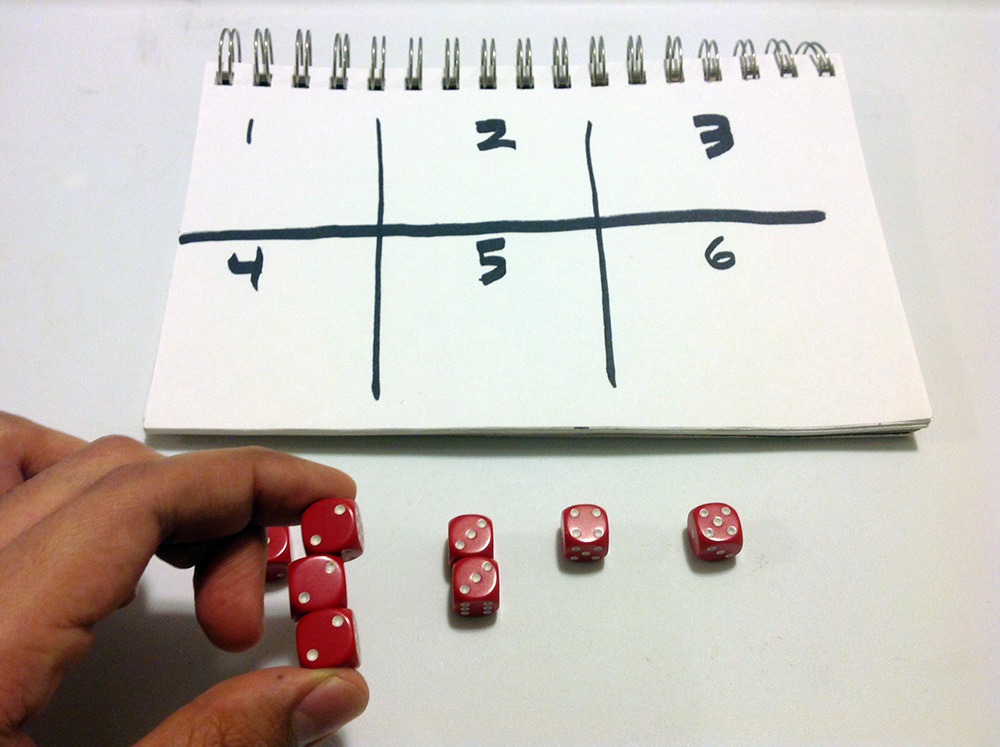
On your turn, you roll the dice pool and sort the results into groups according to their face value. Here we have 1x1, 2x3, 3x2, 4x1, and 5x1.


As the active player, you get first choice from this pool to place one of these groups onto the board. You may place a group onto a space that matches the face value or the size of the group.


So this group of 2x3 could be placed on the "2" space...


...or on the "3" space.


The next player to your left gets to choose another group from the pool to place on the board, following the same rules.


So this 1x5 could be placed on the "1" space...


...or on the "5" space.


Each subsequent player takes one group from the pool and places it on the board until all the dice have been placed. Note that it is possible for players to place more than once on a single turn if there are enough groups to go around the table multiple times, depending on the number of players. For example, if there are six groups and four players, the active player and the player to their left will place twice.

Once all the dice have been placed, that ends your turn as active player.


Thereafter, the player to your left becomes the new active player and begins their turn. They clear the board and reroll the entire pool of dice. They take their first pick of the available groups, followed by the player to their left, and so on, until no dice remain.


But what if there were a map instead of the board?


What if the face value of the set represented the type of dude you could put on the map and the size of the set represented how many you could put on the map? Or vice versa, since large sets are statistically rarer?


Maybe a larger set, like a set of three, allows you to build more substantial structures on the map?

There are a lot of open questions here, but I'm curious to see how it all turns out. What if the game had a map and a board? Assume the theme is dudes exploring this new continent. The board had actions like Settle Dudes, Migrate Dudes, Build Structures, Grow Resources, Harvest Resources Resources, Sell Resources. All of which pertained to various types of bits that are on the board itself? That opens up even more questions! Like, what if the power of these actions varies on a number of different factors? For example:

--~--

Settle Dudes
Place dudes on a space of the map matching the size of the group or the face value.

Face = Number of Dudes

Size : Type of Dudes
1-2: All Farmers
3-4: One (Explorer or Scribe) and all Farmers
5+: Two (Explorer or Scribe) and all Farmers

--~--

Migrate Dudes
Move dudes from one space on the map to an adjacent space of the map.

Face = Number of Dudes

Size : How Many Dudes Perish Along the Way
1-2: Two Dudes
3-4: One Dude
5+: No Dudes

Migrating Explorers raises the set value by one increment. So if you migrate four Farmers, one of them would perish along the way. However, if you replace one of those Farmers with an Explorer instead, that boosts your Size by 1, so it's effectively 5. That means all four of those migrating Dudes would survive the migration.

--~--

Build Structures
Put a structure on a space of the map where you have at least one scribe.

Face = How Much Gold You Earn

Size : How Many Structures You Can Buy
1-2: One Structure
3-4: Two Structures
5+: Three Structures

You may keep as much leftover gold as you have scribes in your chosen space of the map. Actually building anything is optional, so you could just take this action to get some gold.

--~--

Grow Resources
Put resource tiles on a space of the map where you have at least one farmer.

Face = Number of Resources

Size: How Much Control You Have
1-2: All resources randomly drawn from the bag.
3-4: Choose two of the resources.
5+: Choose four of the resources.

Each Farmer you have on a space raises the Size by one increment. So if you used three dice and chose a space where you have two farmers, that effectively raises the Size to 5, allowing you to choose four of the resources.

--~--

Harvest Resources
Take resource tiles from a space of the map where you have at least one farmer. (Note that these don't need to be resources that you grew.)

Face = Number of Resources

Size: How Many Crops are Lost in the Process
1: Three Tiles
2-3: Two Tiles
4-5: One Tile
6+: No Tiles

Each structure on a space will raise the Size by one increment so you lose fewer crops when harvesting.

--~--

Sell Resources
Exchange matched sets of resource tiles for coins or points.

Face = Number of Sets You Can Sell

Size: What You Earn
1: 1 Point and (1 Coins per Set)
2: 3 Points and (4 Coins per Set)
3: 6 Points and (9 Coins per Set)
4: 10 Points and (16 Coins per Set)
5+: 15 Points and (25 Coins per Set)

Sacrificing two Explorers from the same space on the map will boost your Size by one increment.
--~--
So that's just a quick idea from this morning. I must admit I'm a bit overwhelmed at the big open design space available in a 90-minute euro game compared to a 20-minute card game. Hopefully this little dice placement mechanism offers a sensible core loop around which I can build that bigger experience.

Thứ Sáu, 11 tháng 12, 2015

Rhombus for the Rest of Us [Isometric Grids in Tabletop]


I just recently finished Monument Valley, the gorgeous and brain-boggling Escher-inspired puzzle game. It's been around for a little bit, but seems to have had a resurgence since it was a free download last week. Naturally, it got me thinking about how we might use rhombuses and isometric grids in a tabletop game.

Looking at some existing examples, Rome: City of Marble makes some clever use of these grids and emergent patterns, but Monument Valley has that lovely interaction with implied perspective that I really wanted to capture on the table. The Rocca line of games from Japan is closer to what I wanted to see, but still feels relatively linear compared to Monument Valley's three-dimensional gameplay.

All of this converged on two different games I've got on my docket:


Tile-Laying: the Tile-Laying Game

This is a co-design with Drew Hicks. We're both members of the Game Designers of North Carolina and we got to talking about an upcoming "meta" contest from Greater Than Games calling for games where the title is also the central mechanic. (These would be follow-ups to their game Deck-Building: the Deck-Building Game.)

Our idea was a tile-laying game about laying tiles. Initially this was laying tiles in a bathroom, and we started with this rough sketch.

I roughed out a mockup of a tile set with some simple rules: On your turn, lay a tile. When a line is complete, whoever has greatest total ranks on that line scores whatever that line of tiles says to score.


It was an absurdly AP-prone brain-burner, but that's how a lot of my games start. Drew cut back this thorny bush into a more svelte bonsai. The new rule was having a simple majority of tiles was what earned you scoring privileges and the only tiles you could score were your own.


We're also retheming it to be some kind of ancient period mosaic-laden plaza, so the scale of the art can allow for us to add a bit more detail to each individual tile. We're adding a row to the top of that grid that will feature mythological deities that bestow scoring bonuses to the line of tiles below them, from the top of the wall, to the bottom edge of the floor.


Isometric Path-Building Pick-Up-and-Deliver Game

This one's still pretty nascent, but I think the visuals are strong enough to really give it legs in the long run. If there's thing I learned from Kigi and Kodama, it's that people like collaborating building pretty patterns that make passersby stop and look for a moment.

First I mocked up a few hex tiles with the rule that they always feature three paths, each a different color, each connecting two sides of a hex with no overlapping entries or exits.

I placed these hex tiles together and threw on a few meeples to imagine what this game would be like with figures like Monument Valley's hero Ida traversing this weird isometric world along those paths.
What happens when you rotate a hex? Suddenly the implied ceiling becomes a floor. New paths also get created as a result. Are there some interactions with the faces of each implied cube?
Why this player would prefer to traverse along a path that is multi-colored. I wonder if the rule is that you can't enter a new tile unless the path changes color? That may be too counter-intuitive unless the idea is that you're picking up different colored cubes from the corresponding paths and delivering them to differently colored segments of the path.


It was about this time that I realized I didn't have to go through the trouble of making hex tiles when I could make the rhomboid faces of those hexes, thereby allowing players to make their own decisions about whether to make it a hex grid or not. This made some interesting gaps in the grid where a tile couldn't legally be placed. Perhaps those are the destinations for the various deliveries you need to make?


Ever since BGGcon, I've really taken to heart the advice to stretch beyond cards a bit. I'm really enjoying this so far! Hope you're digging the journey as well. :)

Thứ Tư, 25 tháng 11, 2015

Double Discs: A Speed Puzzle Game Idea


I've been told in the past that speed puzzle games don't really sell well, but I saw a lot of Dimension and Dr. Eureka being played at BGGcon, so surely there's some room for that category in the market. Here's a quick idea for a speed puzzle game:

You have 16 discs featuring conceptual pairs on either side of each disc: cat/mouse, dry/wet, sun/moon, city/country, plus/minus etc.

Flip a puzzle card. Two teammates must arrange the discs in the correct shape, with the correct sides visible, within the 30-sec time limit. In the example above, you'd score 1 point for for each disc in the correct position with the correct face visible.

Then you swap out teammates La Boca style and tally individual points across several puzzles.

It's a start, but the kind of component-based design I'm going to develop more often as I explore game ideas beyond the chrome ceiling.

Thứ Tư, 11 tháng 11, 2015

Stowaway: A Quick Idea for a Tavern-Style Card Game


Here's a quick idea for a little tavern-style card game where everyone has a hand of cards, but one of which is moving around secretly from hand to hand. I imagined it as a stowaway on a boat sneaking around trying not to get caught.

---

The Stowaway
A tavern-style card game for large groups, from 5-10 players.

You’re the crew of a pirate ship hiding an innocent stowaway. The Stowaway sneaks from one dark corner of the ship to the next, trying to avoid being caught by the cruel Captain. Eventually the crew will have no choice but to point out where they think is currently harboring the Stowaway.


Setup:
  • From a standard deck of cards, gather two cards per player, minus one.
  • Take the joker and add it to these cards. The Joker is called the Stowaway.
  • Shuffle the cards (including the Stowaway) and deal two cards to each player’s hand.
  • If you ever hold the Stowaway, you’re called an Accomplice.

Gameplay:
Each player simultaneously and secretly passes a card to the player on their left. Repeat this two more times.

Then players discuss where they think the Stowaway is hidden. Players may negotiate and debate as long as they like, but eventually all players must simultaneously count to 3. Then each player must point a finger at who they think is currently harboring the Stowaway. Whoever has the Stowaway must reveal it now.

If you have the Stowaway and fewer than three fingers are pointing at you, you and the Accomplices win.

If three or more fingers are pointing at the player with the Stowaway, anyone pointing at the Stowaway wins. The Accomplice and whoever is harboring the Stowaway loses.

---

This is the bare seed of an idea. Not even tested yet. I'm sure there are all sorts of bugs and broken strategies inherent in it, but I find it useful to get these loose thoughts down into something "discussable." What do you think?

Thứ Hai, 12 tháng 10, 2015

Cardamom: Perhaps a Silly Idea


This weekend I tweeted about a product that I'd been mulling over for some time, but I just thought might be too silly to even try. I was feeling restless though, so I just quickly sketched out some cards by hand. I figure, what the heck, it can't hurt to blog about it.

Cardamom is an expansion for a standard deck of playing cards. It's a separate specialized deck of cards that act as SmashUp-style bases for which players compete by playing standard playing cards. It's a little bit worker-placement and a little bit area control.

Setup

  • Reveal three bases
  • Place them face-up in the center of the play area with plenty of room between them.
  • Keep the base deck nearby face-down.
  • Shuffle a standard deck of playing cards.
  • Deal 5 cards to each player.
  • Keep the card deck nearby face-down.
  • Keep a large supply of chips or paper money nearby. 


How to Play
Players take turns clockwise around the table. Start with the person who last had cardamom.

On your turn, play a card from your hand beside one of the bases. Orient the card so it is clear that you were the one who played it. Unless otherwise noted, you may not play more than one card to a base nor may you place a card on any other player's position around the base.

When you play a card, you may do the action noted on that base. This is optional.

You do NOT draw up to five cards at the end of your turn.

Turns continue until all visible spaces around all the bases have been filled. This ends the round.

Winning Bases
At the end of the round, each base says who will be granted a reward as determined by certain conditions.

New Bases
At the start of a new round, reveal three new bases.

Victory
After the base deck runs out, play out the remaining base(s) as a final round. After the final round, whoever has the most money is the winner.

Example Bases

Playing to this base lets you draw a card. At the end of round, 3♠️ earns $2. K♣️ earns $3. ♥️ and ♦️ earn nothing.

Not all rewards are good! Playing to this base earns $1, but at end of round, 10❤️ loses $2.

Some bases don't offer rewards, but offer useful actions like moving cards to other bases.

Here's an odd base: Play 2 cards to it. Highest total numerical rank gets $5. Any pair of matching suit/rank gets $2.


Conclusion
I call this "Cardamom" mainly for the "card" pun, but I could easily design this to look like some classic tea package designs with some lovely vintage spice illustrations. There might be spices on each base and whoever collects sets of bases with certain spice blends can score extra points at the end of the game. What do you think? Is this a silly idea?