Hiển thị các bài đăng có nhãn business. Hiển thị tất cả bài đăng

Thứ Tư, 8 tháng 6, 2016

Designing the Job – Part 1: What does a game cost the designer?

belle

Most professional tabletop game designers I've met have a day job. This is just anecdotal, but it seems a full time game designer is VERY rare. I’m more of a pro today than I’ve ever been, but most of my household contribution still comes from an aggregate of freelance projects, Patreon, DriveThruCards, and SkillShare. Only a fraction of comes from traditional game design work. And all of that totaled together is still only about a third of what my wife makes at her normal day job.

When I'm working on any game eventually I have to ask myself the scary question:


“Is this game worth designing?”

Is this game costing me too much money? Is it costing too much time? With this series of short articles, I want to share how I figure out whether a game I'm working on is worth designing and, if so, how much I can expect to earn for my time and expense designing it. First up...


How much money has this game cost already?

The most common expense is material costs. My prototypes repurpose sticker paper or bits scrounged from a scrap store, then I endlessly recycle those materials effectively making the material costs free. If I send a prototype to a publisher and it isn’t returned, I have to note that as an expense as well.

When I intend to license my games, I use stock art, public domain art, remixed vectors, or photos to save on the art budget. All of that will usually be changed by the publisher anyway, so it doesn't make sense to spend too much on it.

If I self-publish, I allow myself a small art budget to get some custom illustrations, which significantly helps sales. Lately I make sure I have rights to include this art as part of a future licensing package to another publisher as well.

If I travel to test Game A, B, and C, then I split up my entire expense of that travel between those three games. (This includes event registration, plane tickets, food, etc.)

Let’s look at a hypothetical example: I’ve spent this much designing NOODLE KNIGHT...
  • Material Costs: $50

  • Shipping Costs: $50

  • Art Expense: $500

  • Travel Expenses: $100

So any option for publishing Game A should earn me at least $700 over its lifetime of sales. This is the unusual case where I do intend to self-publish. If I didn't, then I wouldn't have spent so much on the art budget.


How much TIME has this game cost already?

This is an easy number to quantify, but harder to justify. You can easily track how many hours you spend developing, designing, and playtesting Game A, B, and C. But when you translate that to the most minimum wage income, it’s quickly apparent that being a tabletop game designer does NOT pay a competitive hourly rate compared to other careers.

This is where the passion for the job outweighs the practical considerations. Yes, you could earn more spending those same hours doing a less satisfying job, but that just shifts costs to your emotional well-being. We’re in a fortunate and privileged position that I can decide to take a hit to my wallet rather than my happiness.

Returning to the example:
  • If I've spent 50 hours developing NOODLE KNIGHT, that's about ~$360 at North Carolina minimum wage. If I want to earn at least minimum wage from my game, any publishing option should also earn an additional $360 over its lifetime of sales.

You also have to consider how much additional development time you would be willing to spend if the publisher has changes they want to make to the game. Publishers vary in their development practices. Some take the whole game and test their changes in-house without much additional input from the designer, which is great since the designer has presumably already done the vast majority of design work. Some will want changes, but expect the designer to develop them on their time, which just adds to the up-front costs you'd have to negotiate in your contract.

---

Now I have a ballpark goal of about $1060 to earn from my game. The more time or money I spend on the game, the more I'd need to earn to just break even. Beyond a certain threshold, I can't expect a retail license or POD sales to reach that number. That's why I need to keep my material costs low and development time efficient, to make any game I'm working on actually worth working on.

Any professionals out there break down their games like this? Is it too fiddly? Do you have another method of accounting? I'd love to hear it!

Thứ Ba, 24 tháng 11, 2015

BGGcon Recap: Chrome Ceiling, A New Hope, and the Fun Bits!


Alrighty, time for some more long-form thoughts on how BGGcon went for me professionally. I spent most of my time approaching publishers with my prototypes or demoing my self-published games at the main hall with new friends. I had enlightening conversations with several very smart experienced members of the community, including Eric Lang and Kevin Wilson.

I thought going into meetings having just finished a $99,000 kickstarter campaign would be a boost to my credibility, but more people came by talking about my blog, tweets, or my new youtube series. More than once some famous games person came by while I was pitching to a major publisher and say nice things about the game. It was pretty dang awesome.

I got some sobering feedback about the current state of my portfolio, but hopeful advice about the future. Let's start with the sobering stuff first.


The Chrome Ceiling

There was one bit of advice that kept coming up as I worked through each presentation: My games are so optimized for profitable $9 POD sales that there isn't much room to add the bits and "chrome" that would justify at least a $20 retail price tag.

For some background: It takes a lot of work for a publisher to put out any game, regardless of its chrome, but the chrome determines the price consumers are willing to pay for the product. "Chrome" in this case can refer to literal box size, the components, the goodies included as stretch goals, etc.

At retail scales, new components don't add too much manufacturing per unit, but they can command a much higher markup, and thus a more profitable product. On top of all that, a publisher only has a few slots in their yearly schedule to fill with product.

However, I'm faced with a similar choice for my own time. What makes me profit most quickly is these impulse-buy filler games that I can release via POD. There are only so many hours in my day, and my bills still come every month on the clock, so I have to decide which projects are going to be most worthwhile contributions to my household.

So yeah, sobering.


(@npcchris)

A New Hope

All that sounds very grim, but there is hope! Eric Lang suggested I keep cultivating my small games  and focusing on the international licenses, since I apparently have a first mover advantage in those markets. I could keep trying to get games licensed in emerging markets like Brazil and China, where few domestic publishers even pursue licenses in the first place.

That can support my path toward bigger retail-friendly game design. Eric reminded me this is a very, very long-term path, but at the end of that path is a much more sustainable career. Kevin Wilson said when you get your first big game, everything changes. More than one person expressed enthusiasm for what I might do when I'm cut loose from the constraints of POD card games.

They all said I established a rep for making solid games with good sales in my small market. So, my next step is making a few games that I couldn't do on POD or are less optimal in a POD format. For example, Regime is my most expensive product and makes the slimmest profit margin for me because I try to keep most of my games under $9.99.


I upgraded my prototype by tossing out all of the scoring cards, replacing them with chits I mocked up from sticker paper and cardboard. I also replaced the hard-to-handle faction cards with poker chips and sticker paper. I stopped short of making a board, mainly because I already had a very heavy bag I was lugging around, but it could easily have a board for placing the faction cards and chips.

So next year, I'm going to dig into my catalog and see how I could upgrade old games and develop new games with retail in mind.


The Fun Bits!

To be clear, BGGcon was an amazing fun experience. This professional side of things was only about 50% of my con. The rest of it was...


(@MattMorganMDP)
(@KRobVW)
(@GameWireWarrior)
(@425suzanne)
(@eric_lang)
(@BGGgirl)


...so fun!

Thứ Năm, 5 tháng 11, 2015

Sale Sheet Sample: Light Rail

Light Rail - Board Game Sale Sheet - Sell Sheet

I'm going to BoardGameGeekcon for the first time this year and I'm a little nervous! I'm pitching games in a more formal context than I've ever done before. Until now, I've sold three US card games and several international licenses without going through the usual face-to-face pitches and meetings. But it's time to step up a little and do more legwork.

Part of that is making a sale sheet for the games I intend to pitch. Usually sale sheets are sent from a publisher to a distributor as a promotion to get the products out to retailers. In this case, my sheets are one step before that process, going from designer to publisher. Different demands in that case. I followed advice from Jay Cormier and Sen-Foong Lim back in this post from five years ago. I also looked at the Akrotiri sale sheet posted a year later, since I'm a big fan of how that game ended up.

As Jay and Sen recommend, I'll be bringing this sheet and others along with me as a quick pitch tool without having to set up a complete game on the spot. These also make handy leave-behinds with my business cards.

You can download the PDF of Light Rail's sale sheet here. Happy to take feedback!

Thứ Ba, 22 tháng 9, 2015

Creative Cousins: A Tabletop Game Designer Goes To Small Press Expo


For the past three years, my wife has been an active volunteer staffer and coordinator for the Small Press Expo, a long-running comic convention devoted to independent and alternative cartoonists and comics creators. I tag along as a general volunteer floating around the show helping wherever I can. It's a great opportunity to see a vibrant diverse creator community at its most positive and active. Naturally, I couldn't help comparing it to the tabletop community. What follows are my very loose observations and comparisons between the two groups.

(Photo Sources: SPX Facebook)


Shared Challenges
Comics and tabletop games creators both face the same challenge of selling premium physical goods to niche audiences scattered over long distances. Digital and easy-access alternatives are readily available for comics and games, but they're usually lower priced (or free), thus making them loss-leaders in an effort to actually make a living at the trade. Before that can even happen, both creators need to find a critical mass of readers/players who can support creating more of that material.

Comics have the advantage of density and low barrier to entry here. SPX packs in as many creators as a medium-sized game convention in half the space. I was so envious that customers could pick up a comic and start experiencing it right away. No need to find willing co-participants and table space. Lucky ducks. :)


Shared Solutions
SPX thankfully offers a shortcut for creators to reach eager audiences by putting everyone in one place for a whole weekend. Game design conventions like ProtoSpiel, UnPub, and Metatopia offer similar opportunities for tabletop creators. Outside of those shows, crowdfunding options like Patreon and Kickstarter allow both creators to get new income streams and support the creation of more premium products. The best solution both share though? Creator communities sharing their expertise with newcomers.

Comics and games are about on equal footing here, with active communities of independent and part-time professionals all sharing their business experience with each other. With those silos taken down, comics and games both have really fertile ground to bring up new talent in the field and promote existing talent to more full-time work.

Tabletop game publishers would do well to reach out to comics artists from SPX and the larger indie community. They're driven, resourceful, and excited.


The Indie/Pro Pipeline
Speaking of working... Nickelodeon was at SPX this year actively taking pitches from comics creators all weekend. I'm not sure what the later stage plans are with that process, but it was nice to see the procedure so nicely formalized. On the game side, publishers already do this sort of thing at speed-dating events, playtesting conventions, or even reality shows.

That said, I gotta give comics the edge here specifically for one event: The Ignatz Awards. It's a great chance to spotlight and promote independent talent. SPX hands out gold stickers to Ignatz winners to add to their books the following Sunday, thus encouraging more sales. Tabletop's closest equivalent is the Ion awards or the print-and-play competitions on BoardGameGeek, which unfortunately don't yet have the prestige Ignatz has built up over twenty years. Maybe some day!

Still, the process of going from independent to a signed pro are pretty much the same in both industries: Work a lot, in public, on a regular basis.


Where are tabletop's "zines"?
Zines are homemade little books with sketches and comics connected by a single theme. Sometimes they're funny, sometimes they're deeply personal, but they're always low-cost. They offer an even easier point of entry for a curious shopper who may not be ready to buy a high-dollar full-color hardback.

I kept thinking about what tabletop's "zine" equivalent might be and all I could come up with was the Tokyo game market, where homemade games with extremely low print runs get sold directly from the designer. The space at SPX and the game market bear remarkable similarities as well, with shoulder-to-shoulder booths and a broad mix of indie and large publishers. I can't help but wonder if  manga shows set a useful template for Japan's tabletop designers to follow with their own marketplace.

On this side of the Pacific, I should give props to James Ernest for Cheapass Games, which exemplified the zine-style punk rock publishing ethos for years. Today, tabletop role-playing games are ahead of the broader tabletop market, with active business for PDFs, ebooks, and POD books. I think the book part of things is important to take into account, though, as it's much easier to sell that one item than a big heavy box of lux components. Still, POD card games have what it takes to fill that "zine" niche. (I can certainly recommend a few!)

 ----

Phew! Those were my very loose observations from the perspective of an indie tabletop designer. I want to thank the whole SPX crew and crowd for being just 100% awesome all the way through.

I collected a LOT of business cards, which I'm compiling into a pinterest board: Check it out, find some comics to read, and artists to hire!

Thứ Năm, 16 tháng 7, 2015

Game Design Round Table Interview


This week I'm on the Game Design Round Table podcast mainly to ask advice of the prestigious hosts. The topics range from international licensing, to crowdfunding, to generally how to make a living as a game designer. I ramble a bit, as is my habit, but hopefully there are a few cogent points scattered amidst my mad ravings. Please enjoy!

Game Design Round Table Episode 129
  • 0:00:26 – Daniel’s background
  • 0:07:01 – Card counts
  • 0:11:10 – Sharing ideas
  • 0:15:27 – Playtesting
  • 0:18:31 – Kigi
  • 0:22:04 – Publishers in different regions
  • 0:33:39 – International legal matters
  • 0:39:49 – Royalties and crowdfunding
  • 0:53:58 – Upcoming projects
     
Subscribe and review the show on iTunes as well! Please support high quality game design discussion like this show. Thanks!

Thứ Sáu, 1 tháng 5, 2015

Why are board game boxes so big?


After posting the deboxing video earlier this week, discussion turned to just why the heck boxes are so often far larger than their contents. Each publisher has their own reasons and their own financial pressures to make every one of their decisions, but here are some common reasons.

Standardization: It's just plain cheaper to pick from a whole line of readymade boxes of a uniform size rather than make a custom box for each game. Plus, a lot of collectors like uniformity in their shelf display, hence concepts like the Bookshelf series.

Expansion: When a publisher signs a game that they think has a strong potential for long-term sales, it makes sense to plan for expansions ahead of time. (Usually this applies to card games specifically, like deckbuilders.) The extra space in the core box is meant to be filled with those future expansions.

Transport: Having a fair bit of air in the game box (and the shipping box surrounding the game box) helps keep the contents safe and undamaged. I don't necessarily buy this rationale myself, but I've heard enough from industry experts that I'll defer to their expertise.

Marketing: I can't find any market research supporting this, but I hear from retailers that big boxes that face out to the store floor at eye level really help the game sell itself. The bigger the face, the more it catches the eye.

Pricing: Board games are not a high-margin business and it's tough to just get a product to sell its first print run. Despite gripes from BGGers about "buying boxes of air," the box size communicates its price point. The smaller the box, the more it seems like a cheap impulse buy. The bigger the box, the more it seems worth spending an extra $10.

Loss Control: Smaller items are easier for a shoplifter to pocket, so some boxes get artificially inflated to make that more awkward to manage. Anything smaller has to go up front by the register or within eyesight of the clerk. Again, this demotes those products to the impulse buy category. I hear this is less of an issue with some publishers and stores, but it's still a concern in any retail environment.

This may be a good time to mention that all of Smart Play Games have optional deckboxes. If you don't want another box cluttering up your shelf, keep things minimal and just order a card deck on its own. Browse the catalog here!

Thứ Tư, 1 tháng 4, 2015

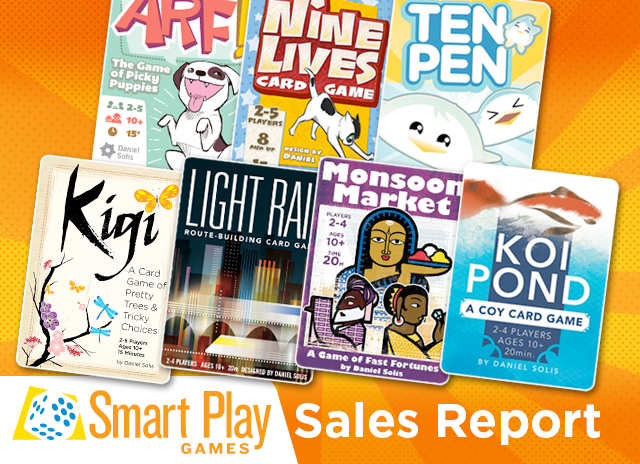
Smart Play Games Sales Report - Q1 2015

Smart-Play-Games---Sales-Report

It's transparency time again for Smart Play Games! I think it's important to be open about how my business runs and how much it earns. When I began this experiment in high-intensity print-on-demand publishing, I had no real sense of what "success" looked like. But I knew it would depend on others jumping into this market as well. But with such an opaque business model, if anyone else wanted to start their own print-on-demand releases, I figured it would be best to show what goes on behind the curtain.


Get on with it!
All that said, here are the raw numbers for this quarter. Top 3 sellers each month are highlighted.

MonthProductTotal SoldGross SalesEarnings
1/1/2015Arf!4$32.96$9.74
1/1/2015Bird Bucks2$13.98$2.44
1/1/2015Kigi17$156.69$47.99
1/1/2015Koi Pond: A Coy Card Game19$199.47$29.48
1/1/2015Koi Pond: Four Walls (Promo Card 2)6$5.94$3.82
1/1/2015Koi Pond: Four Winds (Promo Card 1)6$5.94$3.82
1/1/2015Koi Pond: Moon Temple12$75.88$22.43
1/1/2015Light Rail8$83.92$30.24
1/1/2015Light Rail: Downtown2$12.98$3.39
1/1/2015Monsoon Market10$103.88$19.03
1/1/2015Nine Lives Card Game3$27.97$8.88
1/1/2015Penny Farthing Catapult1$9.99$3.36
1/1/2015Regime3$29.65$1.85
1/1/2015Solar Senate3$25.23$8.04
1/1/2015Suspense: The Card Game14$59.26$19.66
1/1/2015Ten Pen1$9.99$3.35

SUBTOTAL:111$853.73$217.51
2/1/2015Arf!4$35.96$9.74
2/1/2015Bird Bucks1$6.99$1.22
2/1/2015Kigi16$153.84$51.18
2/1/2015Koi Pond: A Coy Card Game11$117.89$18.02
2/1/2015Koi Pond: Four Walls (Promo Card 2)6$5.94$3.82
2/1/2015Koi Pond: Four Winds (Promo Card 1)6$5.94$3.82
2/1/2015Koi Pond: Moon Temple7$44.93$13.08
2/1/2015Light Rail6$63.94$22.68
2/1/2015Light Rail: Downtown2$11.98$3.39
2/1/2015Monsoon Market6$62.94$12.68
2/1/2015Nine Lives Card Game1$9.99$2.96
2/1/2015Regime2$20.98$1.85
2/1/2015Solar Senate1$9.99$4.02
2/1/2015Suspense: The Card Game3$12.97$4.45
2/1/2015Ten Pen1$9.99$3.35

SUBTOTAL:73$574.27$156.28
3/1/2015Arf!3$26.97$7.31
3/1/2015Kigi52$503.91$163.15
3/1/2015Koi Pond: A Coy Card Game23$243.43$36.04
3/1/2015Koi Pond: Four Walls (Promo Card 2)12$11.88$7.64
3/1/2015Koi Pond: Four Winds (Promo Card 1)12$11.88$7.64
3/1/2015Koi Pond: Moon Temple13$81.87$24.30
3/1/2015Light Rail12$123.48$41.58
3/1/2015Light Rail: Downtown2$13.98$3.39
3/1/2015Monsoon Market9$94.89$16.91
3/1/2015Nine Lives Card Game4$39.96$11.84
3/1/2015Regime3$30.97$2.77
3/1/2015Solar Senate1$10.99$4.02
3/1/2015Suspense: The Card Game4$16.96$5.94

SUBTOTAL:150$1,211.17$332.53

Grand Totals:334$2,639.17$706.31

A Slight Change to the Schedule
2014 was a wild year, full of expected pitfalls (low media attention, narrow distribution), fantastic benefits (fast release, limitless inventory), and happy surprises (international licenses). I was releasing new print-on-demand card games each month, along with sales reports that reviewed the previous 30ish days' performance. Those were popular, but took a fair bit of time out of my usual working day. Doing a job, then talking about the job sort of became two jobs. Kinda meta.

This year is a little different, with my focus on long-term projects like Heir to Europa, A La Kart, and Trickster. In fact, I didn't even release new product this quarter! Publicly, it feels like I've gone from warp speed to a screeching halt, but it's only because so much of the development is now local to my area or confined to playtest mailing lists.

So, I'm following the example of Evil Hat Productions and scaling back my sales reports to once a quarter, so you get a better long-tail view of how my little venture is doing.

Kigi Grows in Spring
Kigi quintupled the last two months' sales in just the last ten dasy. I don't know whether it was my posting the youtube tutorial, announcing the Japanese license, or Antoine Bauza publicly purchasing six copies, but wow that's impressive. I've already had five international publishers express interest in the game, which is just bonkers to me. Yowza!

Franchises Keeps Swimming
One of the big challenges facing POD is the high price of shipping. It compels thrifty shoppers to hold off on their purchases until they can make a big bundle order. Koi Pond is unique in my catalog for having two promo cards and a full-on supplement. Having readymade impulse add-ons may be helping keep Koi Pond afloat in the long-term. That's what is giving me more incentive to release game franchises like Trickster and A La Kart: Games that can be purchased as standalone units, or bundle-ordered for better deal on shipping. Then again, Light Rail's Downtown expansion hasn't really performed well, so I should approach this direction carefully.

Dabbling in Paid Advertising
I gave Twitter ads a shot in January, hoping to lift a slumping post-holiday sales period. Unfortunately they didn't perform all that well, even after some adjustments to focus on desktop browsers within the continental United States. I may revisit this in the future with video ads, but for now I'm sticking to "organic" marketing. In other words, tweeting a lot. :P

What's in the Lab?
The past few months have been focused primarily on playtesting A La Kart, editing Heir to Europa, and planning Trickster.
  • A La Kart: With over 60 volunteers on the mailing list, and a cartel of excellent playtesters across the world, the March playtest session was fantastic. Each groups' feedback has been immensely valuable and I'm looking forward to taking A La Kart back into the garage for some retooling. Look for this release in a few months.
  • Heir to Europa: We just posted the rules PDF for Heir to Europa here for your perusal, which is the last step before we go into proper production. Again, feedback here has been great with surprisingly few typos or ambiguities to address. Condensing an eight page rulebook into eight cards was a challenge, but definitely successful. Look for this release in a matter of weeks.
  • Trickster: This game has developed shockingly fast from a paper-thin mechanism to a full-blown light strategy card game for fans of Pairs and Love Letter. It plays as well with 3 players as it does for 7. Lots of plans for decks coming up! I'm very excited about this line's potential. The first release may leapfrog A La Kart by a few months.
And that about covers Q1 2015 for Smart Play Games! Hope this was interesting for you! Feel free to ask any questions!

    Thứ Sáu, 27 tháng 3, 2015

    5 Pitching Lessons from Tabletop Deathmatch (so far)


    I've been watching season two of Tabletop Deathmatch with avid interest. The production values, presentation, and overall organization is light-years past season one. (And season one was pretty good!) To recap: Tabletop Deathmatch is a reality show competition held by Cards Against Humanity and its business partners to find the next great tabletop game.

    The first eight episodes this season focused on introducing and teaching each game in the contest. No judging, just tutorial. This bit was fun to watch for general interest, but I was much more eager to see the subsequent evaluation by a team of top industry judges. So far only four of these judging episodes have been released, but each has offered extremely useful advice for any beginning designer.

    Here are five lessons I've pulled out so far, in no particular order.


    Present the game you have on the table right now. 
    Not the game it could be or the game it used to be. If you've worked on a game a while, it's no doubt gone through dozens of iterations and you've considered a hundreds more future revisions. Regardless, mentioning all of those while teaching, let alone pitching, just muddies the presentation.

    Know your game's weight and set accurate expectations.
     Despite easy rules, there may still be emergent analysis paralysis. I run into this problem too frequently. Because I avoid violent or horror themes in my games, I tend to use nature or cute animals, which in turn seems to imply far lighter games than I typically design. Don't pitch "a light social casual game" when you really have a quiet, contemplative strategy game.

    Listen, learn, but remember you know your game better than they do. 
    It's easy to get intimidated pitching to a veteran games-person, especially if they start calling out mechanics they recognize from other games. That intimidation can turn into defensiveness and perhaps even combativeness. That's no fun for anybody involved. Just remember a 2-minute pitch isn't an ideal presentation scenario for many great games, and even industry vets struggle to explain their games succinctly and accurately.

    Public information slows down decisions. Decisions slow down a pitch. 
    This is more of a general rule of thumb when you're trying to present a game very quickly. Everyone has their own cognitive horizon past which they won't bother analyzing. However, visible information tempts many competitive players to push against their horizon so they can make the "right" decision. Even in a demo! Try framing your pitch so you minimize the decision-time. Spend that time actually explaining the game, rather than waiting for a newcomer to make an informed choice.

    "Failure" in a game should make you excited to play again. 
    At no point should a "fail" state mean that someone doesn't get to actually play the game. "Lose a turn" is basically a cardinal sin in game design. Look at "success" and "failure" as forks in a road, not a traffic light. Either outcome should push the game forward.


    Those are just a few little tidbits I've pulled from the show so far. What have you learned?